
The term agile refers to the flexibility or ability to adapt as and when needed. Agile product development, which today has become synonymous with various frameworks being used, is in essence an approach to product development which makes adaptation to constant changes feasible by running continuous short stints of “requirement to functional readiness” process. Requirements are drip fed into the process and constant feedback and continuous collaboration is encouraged to mature the product over multiple iterations.
A key challenge with the waterfall model that was highlighted in the previous posts was the huge and costly lag before stakeholders get to see the end product. Agile development hits at the heart of this issue by bringing in transparency to the whole process for stakeholders.
An excellent place to start if we want to know more about Agile product or software development movement started is the agile alliance website – https://www.agilealliance.org/agile101/ . It define agile development as
“Agile software development is more than frameworks such as Scrum, Extreme Programming, or Feature-Driven Development (FDD).
Agile software development is more than practices such as pair programming, test-driven development, stand-ups, planning sessions, and sprints.
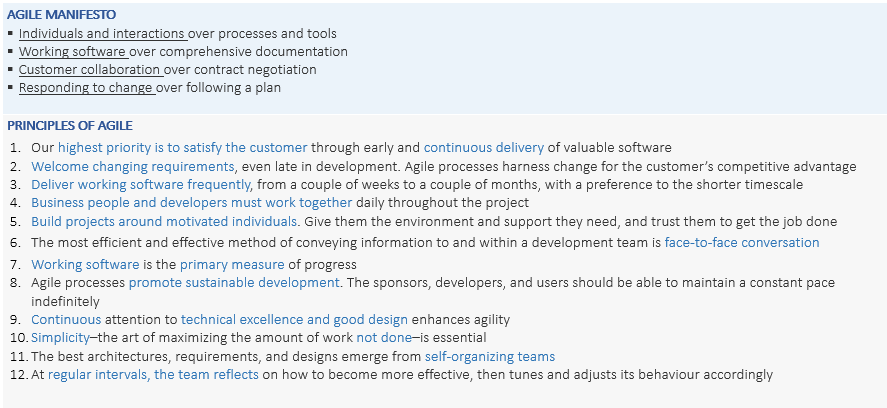
Agile software development is an umbrella term for a set of frameworks and practices based on the values and principles expressed in the Manifesto for Agile Software Development and the 12 Principles behind it. When you approach software development in a particular manner, it’s generally good to live by these values and principles and use them to help figure out the right things to do given your particular context.
One thing that separates Agile from other approaches to software development is the focus on the people doing the work and how they work together. Solutions evolve through collaboration between self-organizing cross-functional teams utilizing the appropriate practices for their context.”
agilealiance.org
For ease of reference, we have provided below the manifesto and 12 principles of agile development as referenced in agilealiance.org.
The immense popularity of the approach in building software and IT products is a huge credit to the authors of ‘Agile Manifesto’ for defining a philosophy which works. It is important to note that the authors have only reiterated that these are the guidelines for building a good product efficiently. Around these guidelines were a set of frameworks developed like scrum, extreme programming etc which defines the methodology to be followed. There are quite a few of these frameworks which gets used today. However one of the more popular ones is Scrum. We will take a look at the Scrum process in the next post.
 ProductSME