
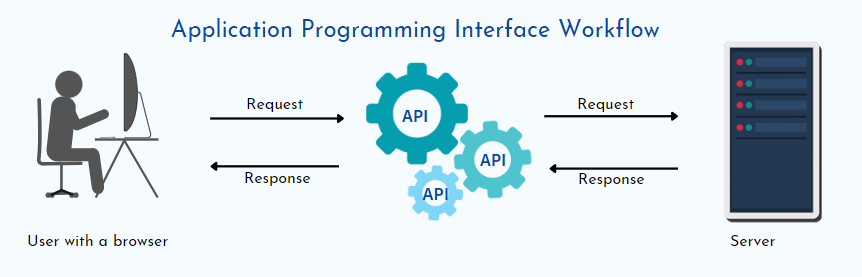
An API, or Application Programming Interface, is a set of rules and protocols that allows different software applications or systems to communicate and interact with each other. It defines the methods and data formats that applications can use to request and exchange information, enabling them to work together seamlessly. APIs are fundamental to modern software development and are used in various contexts, including web development, mobile app development, and integration between different software systems. Here’s an overview of APIs:
Key Characteristics of APIs:
- Abstraction: APIs provide an abstraction layer that hides the underlying complexity of software systems. Developers can interact with an API without needing to understand the internal workings of the system it connects to.
- Standardization: APIs are standardized to ensure consistency and compatibility between different software components. They define a clear set of rules and conventions for communication.
- Interoperability: APIs enable different software applications, regardless of their platforms or programming languages, to communicate and work together. This promotes interoperability and integration.
- Modularity: APIs promote modularity in software design. Developers can build complex systems by combining smaller, reusable components with well-defined APIs.
Types of APIs:
- Web APIs: These are APIs that use HTTP or HTTPS protocols to enable communication over the internet. Web APIs are commonly used for web services, allowing applications to access data or services hosted on remote servers. REST (Representational State Transfer) and SOAP (Simple Object Access Protocol) are common web API architectural styles.
- Library APIs: Library APIs provide a set of functions, procedures, or classes that developers can use within their own code. These APIs are often packaged in software libraries or frameworks, making it easier for developers to leverage existing functionality.
- Operating System APIs: Operating systems provide APIs that allow applications to interact with system resources and services. Examples include Windows API for Windows operating systems and POSIX API for Unix-like systems.
- Hardware APIs: These APIs provide access to hardware components such as graphics cards, printers, and sensors. Developers can use hardware APIs to control and utilize these devices in their software applications.
Common Use Cases for APIs:
- Data Integration: APIs are frequently used to connect different data sources and systems, allowing applications to retrieve, update, and synchronize data in real-time.
- Third-Party Services: Many applications leverage third-party APIs to access external services, such as payment processing, social media integration, mapping and geolocation, and more.
- Microservices: In microservices architectures, APIs play a crucial role in enabling communication between microservices, allowing them to function as independent and scalable units.
- Mobile App Development: Mobile apps often use APIs to access backend services, retrieve data, and provide features like location-based services, push notifications, and social media sharing.
- Web Development: APIs are used to create interactive and dynamic web applications by enabling client-side JavaScript code to communicate with server-side services and databases.
- IoT (Internet of Things): APIs enable IoT devices to communicate with each other and with cloud-based platforms for data collection, analysis, and control.
APIs are a fundamental building block of modern software development, enabling developers to create feature-rich, interconnected applications that can access a wide range of services and data sources. Effective API design and documentation are essential to ensure that developers can use APIs easily and securely.
 ProductSME