Cybersecurity is subject to a complex web of laws and regulations that vary by country and jurisdiction. These laws are designed to protect data, privacy, and critical infrastructure, and they impose legal obligations on individuals, organizations, and governments. Here are some of the key laws and regulations that affect cybersecurity:
General Data Protection Regulation (GDPR): Enforced in the European Union (EU), GDPR sets strict rules for the protection of personal data and imposes significant fines for data breaches. It applies to any organization, regardless of location, that processes EU citizens’ data.
California Consumer Privacy Act (CCPA): This California law gives residents greater control over their personal information held by companies. It requires transparency about data collection practices and allows consumers to request the deletion of their data.
Health Insurance Portability and Accountability Act (HIPAA): HIPAA governs the security and privacy of healthcare data in the United States. It sets standards for protecting sensitive patient information and imposes penalties for non-compliance.
Federal Information Security Management Act (FISMA): FISMA mandates cybersecurity standards for federal agencies in the United States. It requires agencies to secure their information systems and report on their cybersecurity posture.
Cybersecurity Information Sharing Act (CISA): CISA promotes the sharing of cybersecurity threat information between government agencies and private sector organizations to improve collective cybersecurity defense.
Computer Fraud and Abuse Act (CFAA): The CFAA is a U.S. federal law that criminalizes unauthorized access to computer systems and data. It is used to prosecute cybercriminals and individuals involved in hacking activities.
EU Network and Information Security Directive (NIS Directive): The NIS Directive establishes cybersecurity requirements for critical infrastructure operators and digital service providers across EU member states.
Data Protection Laws (Various): Many countries have their own data protection laws that govern the collection, processing, and storage of personal data. Examples include the Personal Data Protection Act in Singapore and the Data Protection Act in the UK.
Cybercrime Laws (Various): Countries around the world have laws specifically targeting cybercrimes, including hacking, identity theft, and online fraud. Penalties for cybercrimes vary by jurisdiction.
National Security and Intelligence Laws (Various): These laws grant governments the authority to conduct cyber surveillance and take action against cyber threats to national security. Examples include the USA PATRIOT Act in the United States.
Critical Infrastructure Protection Laws (Various): Many countries have laws aimed at protecting critical infrastructure, such as power grids and financial systems, from cyber threats. These laws often require specific security measures and reporting.
International Treaties and Agreements: Various international agreements address cybersecurity cooperation and norms in cyberspace, such as the Budapest Convention on Cybercrime and the Tallinn Manual on the International Law Applicable to Cyber Warfare.
These laws and regulations are just a subset of the many legal frameworks that impact cybersecurity. Compliance with these laws is crucial for organizations to avoid legal consequences and to protect sensitive data and critical infrastructure. It’s essential for individuals and organizations to stay informed about the evolving legal landscape of cybersecurity, especially as new laws and regulations continue to emerge.
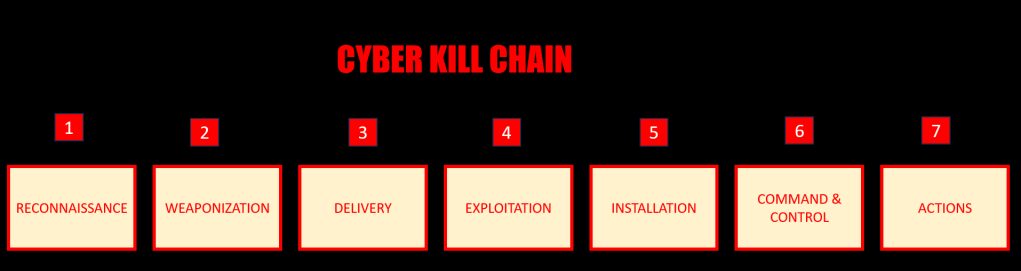
The Cyber Kill Chain is a concept in cybersecurity that describes the stages of a cyberattack, from the initial reconnaissance phase to the final objective, which is often data theft, system compromise, or other malicious actions. Developed by Lockheed Martin, the Cyber Kill Chain framework helps organizations understand and visualize the typical steps attackers take to achieve their goals. By analyzing and disrupting these stages, organizations can enhance their cybersecurity defenses. The Cyber Kill Chain typically consists of seven stages:
1. Reconnaissance:
In this initial stage, attackers gather information about their target. This might involve passive activities like searching the internet, scanning public websites, and social engineering to gather information about the target’s employees, systems, and vulnerabilities.
2. Weaponization:
After gathering information, attackers move to weaponization. They create or acquire malicious tools or payloads, such as malware, viruses, or exploit kits, designed to exploit specific vulnerabilities in the target’s systems.
3. Delivery:
In this stage, attackers deliver the weaponized payload to the target. Common delivery methods include phishing emails, malicious attachments, infected websites, or other means to get the malware onto the target’s network or system.
4. Exploitation:
Once the malicious payload is delivered and executed on the target’s system, the attacker exploits vulnerabilities to establish a foothold within the network. This stage often involves the exploitation of known software vulnerabilities or the use of zero-day exploits.
5. Installation:
After successful exploitation, the attacker installs backdoors, rootkits, or other malicious software on the compromised system. This allows them to maintain access and control over the victim’s network.
6. Command and Control (C2):
Attackers establish communication channels with the compromised systems to control and manage their malicious activities. They use these channels to send commands, exfiltrate data, and maintain persistence.
7. Actions on Objectives:
Finally, in the last stage, attackers carry out their primary objectives, which could include data theft, data manipulation, system disruption, or any other malicious actions they intended to achieve.
The Value of the Cyber Kill Chain:
Understanding the Cyber Kill Chain is valuable for several reasons:
Threat Detection: By recognizing the stages of an attack, organizations can detect and respond to threats at various points in the chain, rather than waiting for an attack to reach its final stages.
Risk Assessment: Analyzing the Kill Chain can help organizations identify vulnerabilities and weaknesses in their security posture, allowing for proactive risk mitigation.
Incident Response: Understanding an attacker’s progression through the Kill Chain can inform incident response efforts, enabling organizations to disrupt attacks before they cause significant harm.
Security Planning: The Kill Chain concept can guide the development of cybersecurity strategies and the selection of security technologies and practices to thwart potential threats.
It’s important to note that while the Cyber Kill Chain provides a valuable framework, not all attacks follow this linear path, and sophisticated adversaries may employ tactics to bypass or disrupt traditional defence mechanisms. Consequently, organizations often supplement the Kill Chain with additional cybersecurity models and strategies to create a comprehensive defence posture.
The CIA Triad, in the context of cybersecurity, is a fundamental framework that defines the core principles of information security. It stands for Confidentiality, Integrity, and Availability. These three principles form the cornerstone of any effective cybersecurity strategy and guide the implementation of security measures to protect digital assets, systems, and data.
1. Confidentiality:
Confidentiality focuses on ensuring that sensitive information remains private and accessible only to authorized individuals, systems, or processes. This principle aims to prevent unauthorized access, disclosure, or leakage of sensitive data. Key aspects of confidentiality include:
Data Encryption: Encrypting data ensures that even if unauthorized parties gain access to it, they cannot understand or use the information without the decryption key.
Access Control: Implementing access controls, such as user authentication and authorization mechanisms, restricts access to data and systems based on user roles and permissions.
Data Classification: Classifying data based on its sensitivity allows organizations to prioritize protection efforts and apply appropriate security controls to different types of data.
Secure Communication: Protecting the confidentiality of data during transmission through secure communication protocols like HTTPS or VPNs.
2. Integrity:
Integrity ensures the accuracy, consistency, and reliability of data and systems. It ensures that data is not altered, tampered with, or corrupted, whether intentionally or accidentally. Key aspects of integrity include:
Data Validation: Implementing data validation checks to ensure that data is accurate and consistent, preventing input errors and tampering.
Digital Signatures: Using digital signatures to verify the authenticity and integrity of messages or files. Digital signatures provide a way to detect unauthorized changes to data.
Change Management: Managing changes to systems and data through controlled processes and version control to prevent unintended modifications.
Data Backups: Regularly backing up data to protect against data loss or corruption and ensuring that backup copies maintain data integrity.
3. Availability:
Availability focuses on ensuring that systems, data, and resources are available and accessible when needed by authorized users. This principle addresses the prevention of disruptions, downtime, or denial of service attacks. Key aspects of availability include:
Redundancy: Employing redundancy in systems and networks to maintain operations even in the face of hardware failures or other disruptions.
Load Balancing: Distributing network traffic across multiple servers to prevent overload and maintain service availability.
Disaster Recovery: Developing and testing disaster recovery plans to recover systems and data in the event of natural disasters, cyberattacks, or other disruptions.
Distributed Denial of Service (DDoS) Mitigation: Implementing measures to detect and mitigate DDoS attacks that can overwhelm and disrupt online services.
Monitoring and Alerting: Continuously monitoring systems for signs of potential issues and setting up alerting mechanisms to respond promptly to anomalies or incidents.
The CIA Triad provides a structured approach to cybersecurity by emphasizing the importance of maintaining a balance between these three principles. It helps organizations identify security risks and select appropriate security controls to protect their digital assets effectively. While the CIA Triad serves as a foundational framework, additional principles and frameworks, such as non-repudiation and the Zero Trust model, can complement and enhance an organization’s overall cybersecurity strategy.
Project management frameworks provide structured approaches and methodologies for planning, executing, and controlling projects, ensuring that they meet their objectives efficiently and effectively. Various project management frameworks have emerged over the years, each with its own set of principles, processes, and tools. In this introduction, we’ll cover some of the most widely recognized project management frameworks.
1. Waterfall: The Waterfall model is one of the oldest and most well-established project management methodologies, known for its sequential and linear approach to managing projects. It provides a structured framework for project execution, where each phase must be completed before the next one begins. This methodology is widely used in industries with well-defined requirements and minimal uncertainty, such as construction and manufacturing. Key Principles of Waterfall Project Management: – Sequential Phases: Waterfall divides the project into distinct phases, each building upon the previous one in a linear fashion. These phases are typically sequential, with no overlap between them. – Requirements Clarity: Waterfall assumes that project requirements can be clearly defined at the outset and will remain relatively stable throughout the project. Changes to requirements are discouraged after the project has started. – Documentation: A significant emphasis is placed on documentation at each phase, including detailed project plans, requirements specifications, design documents, and test plans. – Testing at the End: Testing and quality assurance activities occur primarily at the end of the project, after development is complete. This is known as the “testing phase.” – Customer Involvement: Customer or stakeholder involvement is typically higher at the beginning and end of the project, with less interaction during the development phases.
2. Agile: The Agile model of project management is a highly flexible and iterative approach that has gained widespread popularity in the software development industry and beyond. Unlike traditional, linear project management methods, Agile prioritizes collaboration, adaptability, and customer feedback throughout the project’s lifecycle. Agile projects are divided into small, manageable iterations or increments, often referred to as “sprints” in methodologies like Scrum. Each sprint typically spans a few weeks and results in a potentially shippable product increment. This iterative approach allows for continuous improvement and the delivery of functional pieces of the project at the end of each iteration. It enables teams to respond quickly to changes and emerging requirements. Principles of the Agile Model: – Iterative Development: Agile projects are divided into small, manageable increments or iterations. Each iteration typically lasts two to four weeks and results in a potentially shippable product increment. – Customer-Centric: Agile places a strong emphasis on customer involvement and feedback. It aims to deliver value to customers early and continuously throughout the project, adapting to changing customer needs and preferences. – Cross-Functional Teams: Agile teams are typically composed of cross-functional members with diverse skills, including developers, testers, designers, and business analysts. This diversity ensures that teams can handle a wide range of tasks and responsibilities. – Embracing Change: Agile welcomes changing requirements, even late in the project. It views change as an opportunity to deliver better value and encourages flexibility in response to evolving circumstances. – Transparency: Agile projects maintain transparency through daily stand-up meetings, frequent progress reviews, and highly visible project boards (e.g., Kanban boards or Scrum boards). This transparency helps teams track progress and identify and address issues quickly.
3. Scrum Methodology Scrum is a popular and widely adopted Agile framework for project management and product development, known for its iterative and incremental approach. Originally conceived for software development, Scrum has found applications across various industries due to its flexibility and ability to adapt to evolving requirements. In this comprehensive overview, we will delve into the core principles, roles, ceremonies, and artifacts that define the Scrum methodology Core Principles of Scrum: – Iterative and Incremental: Scrum embraces an iterative and incremental approach to development. It breaks down complex projects into smaller, manageable pieces called “sprints,” each typically lasting two to four weeks. At the end of each sprint, a potentially shippable product increment is delivered. – Empirical Process Control: Scrum relies on empirical process control, emphasizing that knowledge comes from experience and making decisions based on what is known at the time. Teams regularly inspect and adapt their processes to improve outcomes. – Collaboration: Collaboration is at the heart of Scrum. Cross-functional teams work closely together, sharing knowledge and skills. Open and transparent communication fosters collaboration among team members and stakeholders. – Customer-Centric: Scrum places the customer or end-user at the forefront. The product owner represents customer interests, prioritizes work items, and ensures the team is building the most valuable features
4. Kanban: Kanban is a versatile and widely adopted method for visualizing, managing, and improving workflows in various industries. Initially developed in the manufacturing sector by Toyota, it has since been applied to fields beyond manufacturing, including software development, healthcare, and marketing. Kanban, which means “visual card” or “billboard” in Japanese, relies on a visual system to track work items and optimize the flow of work through a process. In this overview, we’ll explore the core principles, practices, and benefits of Kanban. Core Principles of Kanban: – Visualizing Work: Kanban emphasizes the visual representation of work. A Kanban board, typically consisting of columns and cards, provides a visual snapshot of the workflow. Columns represent stages in the process, while cards represent work items or tasks. – Limiting Work in Progress (WIP): One of the central tenets of Kanban is the establishment of WIP limits for each column on the Kanban board. WIP limits define the maximum number of items that can be in progress at any given time. These limits help prevent overloading team members and maintain a smooth flow of work. – Managing Flow: Kanban aims to optimize the flow of work through the system. It encourages work items to move continuously and smoothly from one stage to the next. By managing flow, teams reduce bottlenecks, minimize wait times, and increase overall efficiency. – Making Process Policies Explicit: Kanban makes process policies explicit by defining how work items should move through the workflow. These policies clarify expectations and provide guidance for team members, ensuring consistent practices.
5. PRINCE2 (Projects IN Controlled Environments): PRINCE2 (Projects IN Controlled Environments) is a widely recognized and widely adopted project management methodology used for planning, executing, and managing projects. Developed initially by the UK government, PRINCE2 has become a global standard and is known for its structured and process-driven approach to project management. In this overview, we’ll explore the key principles, components, and benefits of PRINCE2. Key Principles of PRINCE2: – Continued Business Justification: PRINCE2 emphasizes the importance of ensuring that a project remains viable and aligned with the organization’s objectives throughout its lifecycle. Projects should have a clear business case and regular assessments to validate their ongoing value. – Learn from Experience: PRINCE2 encourages organizations to learn from past projects by capturing and applying lessons learned. This promotes continuous improvement and the avoidance of common mistakes. – Defined Roles and Responsibilities: PRINCE2 defines specific roles and responsibilities for project participants, ensuring that everyone knows their role and what is expected of them. Key roles include the project manager, project board, and various project team members. – Manage by Stages: PRINCE2 divides projects into manageable stages, with each stage having its own defined objectives and deliverables. This approach allows for effective control, monitoring, and decision-making at each stage. – Manage by Exception: PRINCE2 sets predefined tolerances for each project stage and allows project managers to manage by exception. This means that they can take corrective actions when a stage deviates from the predefined tolerances without seeking constant approval from senior management. – Focus on Products: PRINCE2 emphasizes the importance of clearly defining and managing project deliverables (products). This ensures that the project’s output meets quality and scope expectations. – Tailoring to Suit the Project: PRINCE2 is adaptable and can be tailored to suit the specific needs and characteristics of each project, whether it’s large or small, simple or complex
6. PMBOK (Project Management Body of Knowledge):The Project Management Institute (PMI) is a globally recognized organization that has developed a comprehensive framework for project management known as the Project Management Institute Framework or PMI Framework. This framework is described in the PMI’s flagship publication, the “Project Management Body of Knowledge” (PMBOK) Guide, which provides guidelines, best practices, and standard processes for managing projects effectively. In this overview, we’ll explore the key components and principles of the PMI Framework. Principles of the PMI Framework: – Project Management Knowledge and Practices: PMI emphasizes the importance of applying project management knowledge and practices derived from the PMBOK Guide to manage projects effectively. – Tailoring: The PMI Framework promotes tailoring project management processes to fit the specific needs of each project. One size does not fit all, and flexibility in application is encouraged. – Ownership: Successful project management requires clear roles and responsibilities for all project stakeholders, with an emphasis on leadership and accountability. – Adaptation: The PMI Framework recognizes that projects may require adaptation to changes in their environment and should be flexible in responding to those changes
7. Lean Project Management: Lean Project Management is a methodology that combines principles from Lean Thinking and project management to enhance the efficiency, productivity, and value delivery of projects. It aims to eliminate waste, optimize processes, and improve project outcomes by focusing on customer value, continuous improvement, and the reduction of non-value-adding activities. In this overview, we’ll explore the key concepts and principles of Lean Project Management. Principles of Lean Project Management: – Specify Value from the Customer’s Perspective: Define what is valuable to the customer and ensure that project activities align with these customer-defined values. – Identify the Value Stream: Map the end-to-end process of delivering value to the customer, identifying all steps and resources involved. – Create Flow: Streamline the process to create a smooth, continuous flow of work, minimizing interruptions, bottlenecks, and handoffs. – Establish Pull: Implement a pull system where work is initiated based on demand, reducing overproduction and excess inventory. – Seek Perfection: Continuously strive for perfection by eliminating waste, improving processes, and increasing the efficiency of value delivery.
8. Scaled Agile framework: The Scaled Agile Framework (SAFe) is a comprehensive and widely adopted framework for scaling Agile principles and practices to large organizations. SAFe provides a structured approach to implementing Agile methodologies, such as Scrum and Kanban, across multiple teams, departments, and even entire enterprises. It is designed to help organizations deliver value more efficiently, improve quality, and foster collaboration at scale. In this overview, we’ll explore the key components and principles of SAFe. SAFe Principles: SAFe is guided by several core principles, including: – Take an Economic View: SAFe encourages organizations to make decisions based on economic factors, ensuring that investments in Agile development deliver value. – Apply Systems Thinking: Organizations should consider the entire value stream and understand how changes impact the system as a whole. – Assume Variability; Preserve Options: Embrace change and keep options open for as long as possible to adapt to evolving requirements. – Build Incrementally with Fast, Integrated Learning Cycles: Use short feedback loops to continuously learn and adapt. – Base Milestones on Objective Evaluation of Working Systems: Assess progress based on working solutions and deliverables. – Visualize and Limit WIP, Reduce Batch Sizes, and Manage Queue Lengths: Use principles from Lean manufacturing to optimize work processes and reduce waste.
Definition: Project management is the discipline of planning, executing, controlling, and closing a specific set of tasks or activities with a defined beginning and end to achieve a unique objective or deliverable.
Scope: Projects are temporary endeavors with well-defined boundaries, goals, and deliverables.
Responsibility: Project managers are responsible for managing individual projects, including scope, schedule, budget, quality, and resources.
Focus: The primary focus of project management is to deliver the project on time, within budget, and meeting quality standards.
Examples: Developing a new software application, constructing a building, organizing a marketing campaign.
Program Management
Definition: Program management is the management of a group of related projects and initiatives that are coordinated and managed together to achieve strategic objectives.
Scope: Programs are composed of multiple interrelated projects and initiatives that collectively contribute to a broader organizational goal.
Responsibility: Program managers are responsible for aligning the projects within the program with the organization’s strategic objectives, managing interdependencies, and ensuring efficient resource allocation.
Focus: The primary focus of program management is to ensure that the collective output of the projects in the program delivers the intended benefits and value to the organization.
Examples: Implementing an enterprise-wide IT system that includes multiple projects (e.g., software development, hardware deployment, training) or managing a portfolio of research and development projects.
Portfolio Management
Definition: Portfolio management is the management of a collection of programs, projects, and initiatives to prioritize and align them with an organization’s strategic goals and objectives.
Scope: Portfolios encompass all projects, programs, and initiatives within an organization, regardless of their size or complexity.
Responsibility: Portfolio managers are responsible for selecting, prioritizing, and managing a balanced portfolio of projects and programs that align with the organization’s strategic priorities.
Focus: The primary focus of portfolio management is to maximize the organization’s return on investment (ROI), ensure resource optimization, and maintain alignment with the strategic direction.
Examples: Managing a portfolio of projects and programs across various business units, such as IT projects, product development initiatives, and marketing campaigns.
In today’s interconnected world, where information flows seamlessly across the web, and technology touches nearly every aspect of our lives, the need for robust cybersecurity has never been greater.
As we dive into this fascinating subject, let’s begin by taking a brief journey through the history and evolution of cybersecurity. It’s a tale of innovation, adaptation, and relentless battles in the digital frontier.
The Genesis of Cybersecurity:
In the early days of computing when colossal mainframes occupied entire rooms and punched cards held the keys to data storage. During this era, security concerns were relatively simple—physically securing the computer and its punch cards was paramount.
But as technology advanced and the digital landscape expanded, so did the vulnerabilities. The birth of the internet in the late 20th century marked a turning point. Suddenly, computers could communicate across vast distances, and with this newfound connectivity came new threats. The first computer viruses emerged, exploiting weaknesses in early operating systems.
The Age of the Internet:
With the internet’s proliferation, cyberattacks evolved rapidly. Hacking became a dark art, and individuals with malicious intent sought to exploit the digital realm for financial gain, espionage, or simply chaos. The term “cybersecurity” was coined to describe the practice of protecting computer systems and networks from these threats.
As businesses and governments adopted digital technologies for critical functions, the need for robust cybersecurity measures became evident. The 21st century witnessed the rise of complex malware, sophisticated hacking groups, and large-scale data breaches that shook industries and nations.
Cybersecurity Today:
Fast forward to the present day, where our interconnected world is defined by cloud computing, mobile devices, the Internet of Things (IoT), and artificial intelligence. Cybersecurity has evolved into a multi-faceted discipline that encompasses threat detection, encryption, risk management, and compliance with ever-changing regulations.
But with every stride in defence, cyber adversaries take a leap in offense. The battle between cybersecurity experts and hackers is relentless, and it’s waged not only in corporate boardrooms and government agencies but also on the devices in our pockets and homes.
A credit card is a payment card issued by a financial institution, such as a bank, that allows the cardholder to borrow funds up to a certain limit in order to make purchases or withdraw cash. When the cardholder makes a purchase, the amount is deducted from their available credit limit. The cardholder is then required to make a minimum monthly payment, which is typically a percentage of the total balance, along with any interest and fees. If the cardholder does not pay the balance in full by the due date, interest is charged on the remaining balance.
When a credit card is used to make a purchase, the transaction information is sent to the card issuer (the bank or financial institution that issued the credit card) for authorization. This information includes the cardholder’s account number, the merchant’s identification number, and the purchase amount.
The card issuer then checks to see if the cardholder’s account is in good standing and if the requested purchase amount is within the cardholder’s credit limit. If the account is in good standing and the credit limit has not been exceeded, the card issuer sends an approval code to the merchant, allowing the transaction to be completed.
The approval code is sent via the payment network (such as Visa or Mastercard) to the merchant’s acquiring bank, which then sends the request to the card issuer for final approval. Once the card issuer approves the transaction, the acquiring bank sends a message to the merchant to proceed with the sale. The merchant will then charge the amount of the purchase to the cardholder’s account.
The technical process behind this is known as Electronic Funds Transfer (EFT) and it works through a secure network that connects the merchants and the card issuers. The process uses advanced encryption and authentication protocols to ensure the security of the transaction.
What are the various parties involved in a credit card transaction
There are several parties involved in a credit card transaction:
Cardholder: The person who owns the credit card and uses it to make purchases or withdraw cash.
Merchant: The business or organization that accepts the credit card as a form of payment for goods or services.
Card issuer: The financial institution, such as a bank, that issued the credit card to the cardholder. The card issuer is responsible for approving or declining transactions and issuing credit to the cardholder.
Payment network: The system or network that facilitates the communication and transfer of information between the merchant, card issuer, and cardholder. Examples of payment networks include Visa, Mastercard, American Express, etc.
Acquiring bank: The bank or financial institution that handles the merchant’s credit card transactions. It is responsible for routing the transaction information to the card issuer for approval and transferring funds from the card issuer to the merchant.
Independent Sales Organizations (ISOs) and Merchant Service Provider (MSP) : ISOs and MSPs acts as intermediaries between merchants and financial institutions, providing the necessary equipment and services for merchants to accept card payments.
Payment Gateway: A payment gateway is a software that acts as a bridge between merchants and the payment processors, enabling merchants to accept credit card payments online.
All these parties play a role in a credit card transaction and work together to ensure that the purchase is completed securely and efficiently.
What are the various platforms involved in a credit card transactions?
There are several platforms involved in a credit card transaction:
Point of Sale (POS) Terminal: A POS terminal is a device that merchants use to process credit card transactions. It can be a physical terminal or a virtual terminal that allows merchants to process transactions online.
Payment Processor: A payment processor is a company that handles the electronic transfer of funds between a merchant and a card issuer. It acts as the intermediary between the merchant and the payment network, ensuring that transactions are secure and compliant.
Payment Gateway: A payment gateway is a platform that facilitates the communication and transfer of information between the merchant, payment processor, and card issuer. It encrypts and processes the transaction data, ensuring the security and compliance of the transaction.
Fraud Detection and Prevention Systems: These are systems and platforms that are used to detect and prevent fraudulent activities on credit card transactions. They use various methods such as machine learning, artificial intelligence, and other analytical tools to identify and flag suspicious transactions.
Settlement Systems: Settlement systems are platforms used to facilitate the transfer of funds between the merchant and the card issuer, and reconcile the transactions.
Virtual Terminal: A virtual terminal is a web-based platform that allows merchants to process credit card transactions online. This platform can be used by merchants that don’t have a physical store or by businesses that process transactions from remote locations.
All these platforms work together to ensure that credit card transactions are processed quickly and securely, and that the funds are transferred to the merchant in a timely manner.
A debit card is a payment card that allows users to access funds in a checking or savings account in order to make purchases or withdraw cash. Debit cards are linked directly to a bank account, and when a purchase is made, the funds are transferred from the account to the merchant. The money is deducted from the account balance in real-time.
When a debit card is used to make a purchase, the cardholder must enter a personal identification number (PIN) to verify their identity. Some debit cards also have a magnetic strip or a chip that contains the cardholder’s account information, which is read by a card reader at the point of sale.
When a debit card is used for an online purchase, the cardholder must provide the card number, expiration date, and security code.
Debit cards are an alternative to cash and check payments. They are also an alternative to credit cards, as debit card transactions are deducted from the account balance in real-time, and the cardholder can only spend what they have available in their account. This can help to prevent overspending and build a good credit score.
Debit cards are commonly used for everyday purchases such as groceries, gas, and online purchases and also for withdrawing cash from an ATM
How does the process works
When a debit card is used to make a purchase at a physical point of sale, the card is inserted into a card reader, or the card’s magnetic strip or chip is read by the reader. The card reader then sends a request for authorization to the card issuer through the card network (such as Visa, Mastercard, etc.) The card issuer, in turn, verifies the cardholder’s account information and available balance, and sends an approval or decline message back to the point of sale. Once the transaction is approved, the funds are transferred from the cardholder’s account to the merchant’s account.
For online transactions, the cardholder provides the card details, including the card number, expiration date, and security code, to the merchant. The merchant then sends a request for authorization to the card issuer through the card network. The card issuer verifies the cardholder’s account information and available balance, and sends an approval or decline message back to the merchant. Once the transaction is approved, the funds are transferred from the cardholder’s account to the merchant’s account.
In summary, the debit card works by electronically linking a bank account to the card, and upon a purchase or withdraw, the funds are transferred from the account to the merchant or ATM, respectively, in real-time. Additionally, the transactions are also authenticated by a PIN for added security.
A debit card is a payment card that allows users to access funds in a checking or savings account in order to make purchases or withdraw cash.
Describe the intermediaries involved in debit card processing ?
Debit card processing involves several intermediaries, including:
Issuing Bank: The financial institution that issues the debit card to the customer.
Payment Processor: A company that handles the electronic transaction between the customer, the merchant, and the acquiring bank.
Acquiring Bank: The financial institution that provides the merchant with the ability to accept debit card payments
Card Associations (e.g. Visa, Mastercard): Organizations that oversee the debit card network, set standards, and facilitate transactions between issuing and acquiring banks
Switch: A network that routes the transaction information to the appropriate card association and then to the issuing bank for authorization.
Interchange: The fee paid by the acquiring bank to the issuing bank for each transaction processed.
Point of Sale (POS) System: The device or software used by merchants to process debit card transactions.
These intermediaries work together to process and complete a debit card transaction, from the moment the customer swipes or dips their card at the point-of-sale terminal to the final settlement of funds between the issuing and acquiring banks.
What are the salient features of Debit Card?
A debit card is a payment card that deducts money directly from a consumer’s checking account to pay for a purchase. Some of the main features of a debit card are:
Direct access to funds: Debit cards provide instant access to the funds in your checking account.
No credit check: You don’t need to go through a credit check to obtain a debit card, unlike a credit card.
PIN-based transactions: Debit cards are typically linked to a personal identification number (PIN), which is used to secure transactions.
ATM access: Debit cards can be used to withdraw cash at ATMs, deposit money, and check account balances.
Acceptance: Debit cards are widely accepted by merchants for purchases and online transactions.
Overdraft protection: Some debit cards come with overdraft protection, which helps prevent accidental overdrafts of your checking account.
Fees: Some banks may charge fees for using debit cards, such as annual fees, foreign transaction fees, or overdraft fees.
Fraud protection: Debit cards come with fraud protection, which helps protect you from unauthorized transactions.
SWIFT stands for the Society for Worldwide Interbank Financial Telecommunication. It is a global financial messaging network that enables the secure exchange of electronic messages and financial transactions between financial institutions. These messages and transactions include things like international money transfers, securities transactions, and automated clearinghouse transactions. The system is used by over 11,000 financial institutions in over 200 countries and territories. SWIFT does not handle the actual funds being transferred, but instead sends payment order messages between banks, which then settle the transaction using their own systems.
How does the SWIFT infrastructure work?
The SWIFT infrastructure is made up of a network of correspondent banks that are connected to the SWIFT system. Each bank has its own unique Bank Identifier Code (BIC) that is used to identify it on the SWIFT network. When a bank wants to send a message or initiate a financial transaction, it sends the message to its correspondent bank, which then forwards the message to the appropriate recipient bank using the BIC.
The SWIFT network uses a standardized messaging format for all of its financial transactions and messages, which ensures that all of the participating banks are able to understand and process the information contained in the messages. This messaging format is called the SWIFT message format.
All the communication across the network is encrypted and authenticated to ensure the security of the financial transactions and messages being exchanged.
The SWIFT network is overseen by the SWIFT Operations Center, which is responsible for the day-to-day operation and maintenance of the SWIFT infrastructure, and the SWIFT Policy and Standards division, which sets the policies and standards that govern the use of the SWIFT network.
When was SWIFT created?
The Society for Worldwide Interbank Financial Telecommunication (SWIFT) was established in 1973, with the goal of creating a secure and standardized system for financial institutions to exchange electronic messages and financial transactions. At the time, most financial transactions were still done via telex and other manual methods, which were slow and prone to errors.
In the 1970s, SWIFT began working with a group of international banks to develop a system for electronic messaging that could be used for financial transactions. The first SWIFT messages were sent in 1977, and by the early 1980s, the network had grown to include more than 250 banks in 25 countries.
In the following years, SWIFT continued to expand its network, adding new services and functionality to meet the evolving needs of its customers. In the 1990s, SWIFT introduced the SWIFTNet messaging platform and the SWIFT Alliance Access, which provided a secure gateway to the SWIFT network for financial institutions.
In the early 2000s, SWIFT introduced a number of new services, including the SWIFTNet FileAct and SWIFTNet Browse, which were designed to improve the efficiency and security of file transfer and message browsing on the SWIFT network.
In recent years, SWIFT has been investing in new technologies and services, such as SWIFTNet Link and SWIFTNet Secure IP Network (SIPN), to support the growing demand for secure and reliable financial messaging and transactions. Today, SWIFT is used by more than 11,000 financial institutions in over 200 countries and territories, and continues to be a key player in the global financial system.
Who runs SWIFT?
SWIFT is a cooperative society owned and governed by its member financial institutions. It is headquartered in Belgium and is controlled by G10 central banks as well as ECB. The organization has also several other offices around the world, such as Singapore, Hong Kong, Sydney, New York and London, to better serve its member banks in different regions, and to be closer to the regulatory authorities in those regions. The organization is run by a Board of Directors, which is elected by the membership. The Board of Directors sets the overall strategic direction for SWIFT and is responsible for the overall management of the organization.
The day-to-day operations of SWIFT are managed by the Chief Executive Officer (CEO), who is appointed by the Board of Directors. The CEO is responsible for the implementation of the strategic plan and for managing the various departments within SWIFT, including the SWIFT Operations Center, which is responsible for the day-to-day operation and maintenance of the SWIFT infrastructure.
In addition to the Board of Directors and the CEO, SWIFT has a number of other governing bodies, such as the SWIFT Policy and Standards division, which sets the policies and standards that govern the use of the SWIFT network, and the SWIFT User Group, which represents the interests of SWIFT users.
What systems does SWIFT use to process financial messages?
SWIFT uses a number of different systems to process messages on its network. These include:
SWIFTNet: This is the messaging platform used by SWIFT to exchange financial messages and transactions between financial institutions. It uses a standardized messaging format, called the SWIFT message format, to ensure that all of the participating banks are able to understand and process the information contained in the messages.
SWIFT Alliance Access: This is a secure gateway to the SWIFT network, which enables financial institutions to connect to the SWIFTNet messaging platform and exchange messages and transactions with other institutions.
SWIFTNet FileAct and SWIFTNet Browse: These are used for file transfer and browsing of messages respectively. FileAct enables the transfer of large files, such as payment files, between financial institutions, while Browse allows institutions to view and manage their messages on the SWIFT network.
SWIFTNet Link: This is a software solution that enables financial institutions to connect to the SWIFT network via the internet, rather than through traditional leased lines.
SWIFTNet Secure IP Network (SIPN): This is a dedicated, secure, and highly available network infrastructure that connects financial institutions to the SWIFT network.
All these system are overseen by the SWIFT Operations Center, which is responsible for the day-to-day operation and maintenance of the SWIFT infrastructure.
All the communication across the network is encrypted and authenticated to ensure the security of the financial transactions and messages being exchanged.
Payment refers to providing a consideration in exchange for a good or service of value.
The history of payments goes back to early civilizations, where different forms of currency and bartering were used to exchange goods and services. In early civilizations, people used items such as cattle, grains, and precious metals as forms of currency. Later, coins and paper money were introduced as a more standardized form of currency.
In ancient Mesopotamia, clay tablets were used to record transactions, which is considered as the earliest form of writing. In ancient Egypt and China, metal coins were used as a form of currency. The use of coins and paper money spread throughout the world over time.
During the Middle Ages, the barter system and the use of precious metals such as gold and silver were popular. In the Renaissance period, the use of bank notes and checks began to gain popularity. In the 19th century, credit and debit cards, electronic funds transfers, and online payments emerged.
In recent years, digital currencies and mobile payments have become increasingly popular. The advent of blockchain technology has also led to the development of new forms of digital currency, such as Bitcoin
The following infographics gives a very creative view of the origin and evolution of payments – https://www.visualcapitalist.com/the-history-of-money-explained-infographic/ (Side note: For those interested visualcapitalist.com as wealth of infographics catering to a wide variety of topics. Very informative. Do check it out)
In the current world, money backed by central banks has become the most common medium of consideration. The Economist highlights three main qualities of money, “as a medium of exchange, buyers can give it to sellers to pay for goods and services; as a unit of account, it can be used to add up apples and oranges in some common value; as a store of value, it can be used to transfer purchasing power into the future.
Here are some important dates in the evolution of payments
2500 BC: Metal coins are first recorded in use in ancient Mesopotamia and ancient Egypt.
1200 : The use of paper money begins in China.
1400: Banks are established in Europe and begin to issue bank notes.
1600s: Bank notes and checks begin to gain popularity in Europe.
1775 : The first credit card is invented by a man named Edward Bellamy.
1875: The first patent for a “cash register” is granted to James Ritty, an American inventor.
1950: The first credit card, called the “Diner’s Club Card,” is introduced in the United States.
1967: The first automated teller machine (ATM) is installed in London.
1971: The first electronic funds transfer (EFT) system is introduced in the United States.
1990: The first online shopping transaction takes place over the Internet.
2008: The creation of Bitcoin, the first decentralized digital currency, is announced by the pseudonymous person or group “Satoshi Nakamoto.”
2011: The first mobile payment is made using a smartphone.
2015: The European Union launches the “Single Euro Payments Area” (SEPA) to facilitate cross-border electronic payments within the EU.
2020: The usage of contactless payments, mobile payments, and digital wallets increases due to the COVID-19 pandemic.








 ProductSME