
Defining a well thought Product Strategy

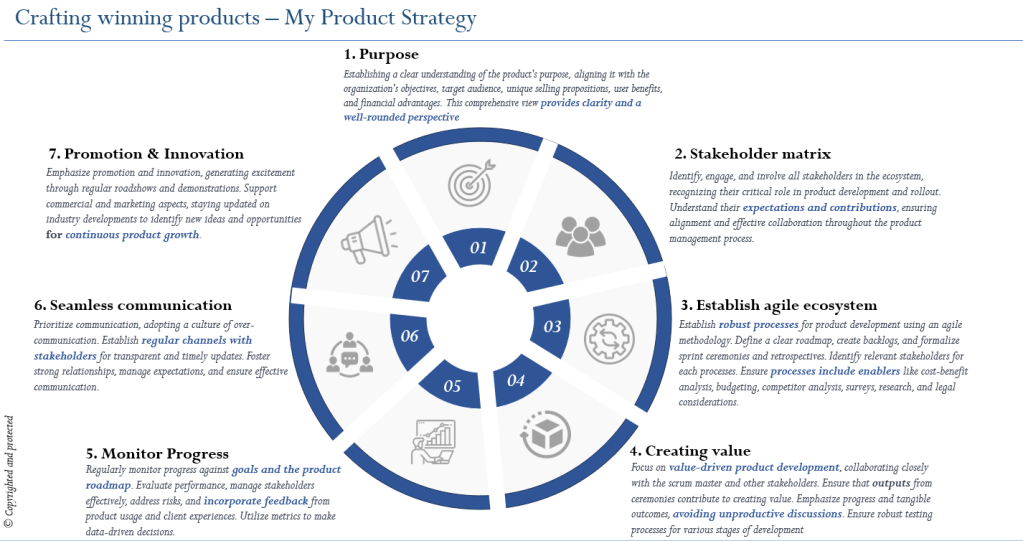
Success of a product greatly depends on a well-defined product strategy which acts as a compass that guides organizations. It provides clarity, aligns objectives, and ensures that products are not just developed but thrive in the market. I have refined and relied on seven keys to developing a robust product strategy. The keys include mission & purpose, stakeholders landscape, product development process, value creation, progress monitoring, seamless communication, and promotion & innovation. Let’s delve into each of these steps to understand how they contribute to a comprehensive and effective product strategy.

Step 1: Purpose – Defining the North Star

A product strategy begins with a clear understanding of the product’s mission purpose. I find this step fundamental for establishing the right direction for the product for the obvious reason. Without mission, without knowing what difference you expect the product to make in the ecosystem, without knowing  what values your product stand for , without knowing what problem it aims to solve there is no product. But mission is not the only thing what we need to confirm at this stage. There are host of others which I have listed below:

  • Define product mission, values

As mentioned this is critical. Define a grandiose mission. Something like Product XYZ will be the top product of choice when the user wants to solve ‘problem’ or fill a ‘gap’ or Product XYZ will capture 40% of world market due to its transformational prowess. It needs to be BOLD, it need to be BIG. Anyone who is associated with the product should feel that they are backing a truly disruptive product, they should feel energised, proud of what the product does or is expected to do

  • Define the product market

We need to identify the market segment where we want to be product leader. Market segment define our subsequent approach on go to market, market research, identifying and tracking competition

  • Define what product success will look and feel like

It is important to establish what product success looks like over one year, 2 year , 5 year. It can be increase in market share or growing revenue from the product

The above steps will enable the product team to create a well-rounded perspective that serves as the guiding light throughout its lifecycle. This clarity ensures that every decision, from development to marketing, is aligned with the product’s core mission.

Step 2: Stakeholder Landscape- Collaborative Engagement

Once we have clarity on what the long term goals of the product, it is important to understand the stakeholder landscape which impacts the product. Obviously the most important stakeholder for the product will always be the ‘Customer’. But apart from Customer there are other stakeholders which need to be identified along with their stakes in the product. This is critical as understanding the stakes of respective groups will ensure that engagement model with each of the stakeholder gets defined which in turn will lead to the right outcome for the product and the organisation. Key categories of stakeholders that need to be considered are:

  • Customers
  • Competitors
  • Sponsors and Management
  • Business Development
  • Other Internal Departments
  • Product Development Team

For each category of stakeholders a set of questions need to be answered:

  • What is the role of the stakeholder vis a vis the product
  • What is the expectation of the stakeholder
  • How does the product team plans to engage with the stakeholder
  • What is the information (if any) needed from the stakeholder and at what frequency
  • What is the information (if any) to be shared with stakeholder and at what frequency
  • What is the engagement model with each of the stakeholders
  • How will the inputs from any of the stakeholder make its way back to if required to refine the vision or the product roadmap or backlog

We will define each of the above stakeholder along with a framework in a separate article

Step 3: Establish an Agile Ecosystem – Navigating the Development Journey

Assuming we plan to use the agile framework for building the framework, it is essential to establish an effective governance model for managing the product development. This can again be explained through a set of questions which should be answered:

  • How many sub products will the product build be split into?
  • How long will be the sprint cycle
  • What will be an ideal cross functional team? How many teams would be needed
  • What will be the sprint acceptance process?
  • Establishing standards of user stories
  • Process for sprint planning, sprint refinement, sprint retrospective
  • Tools to be used for managing backlog and roadmap
  • How will the outputs from stakeholder engagement model be incorporated with the backlog and roadmap
  • Clarity on right level of update for various stakeholders
  • Clear understanding with technology around deployment, testing and path to live

A scum master along with product manager and technical lead should take an active lead  in this space. Having these questions sorted right at the beginning ensures the actual build and rollout of the product is highly efficient.

Step 4: Creating Value – The Heart of Product Development

This is where the rubber meets the road, where the Product Manager would ensure that product roadmap along with product backlog starts taking shape based on the requirements gathered. Requirements are nothing but the result of the interaction with the interaction with various stakeholder groups. Without doubt customers will provide majority of the requirements but requirements can also come from other stakeholders as well. For instance compliance team can provide specific requirements related to GDPR regulations, technology team can highlight requirements related to cyber security and so on. In this step sprint is put into action where the structure put in place for product development starts churning out features iteratively. Features are tested, reviewed and feedbacks are gathered and the cycle repeats.

After a set of features are ready, they are packaged as a version of the product and then tested across environments before being made ‘live’ in the production environment. Important to note that based on the strategy the rollout of the version can start with a small group of targeted users and when the team feels adequately confident with the version, the same can be rolled out to wider audience. There are loads of idiosyncrasies involved in this area something we can cover at length when we discuss individuals at length

Step 5: Monitor Progress – Data-Driven Decision Making

It is a well-established control maxim that what cannot be measured cannot be controlled. So is true with product as well. Regularly monitoring progress against goals and the product roadmap is essential for steering the product in the right direction. Customer feedback is the pulse of the product health. Reactions and feedbacks from the customers need to be systematically gathered, assessed, converted to requirement and added to the backlog. Similarly Product team should ensure that outcomes of monitoring and analysis of various areas like technology, entity risk management, operations are managed well. The follow up action from monitoring and control initiatives need to be give n high priority with periodical review and disciplined addressing of each and every assessment/ feedback/ complaints etc. Metrics play a crucial role in making data-driven decisions, providing insights into what is working and where adjustments are needed. Continuous progress monitoring ensures that the product remains on track to achieve its objectives.

Step 6: Seamless Communication – The Glue that Binds

If you review any of the previous steps, it will be obvious that communication will be an integral part of it. However I have specifically called out communications as an independent area due to its criticality in the overall product management approach. Especially given its never a case that one size fits all  when it comes to communicating. So the communication with the customers’ needs to be a different approach than the one with top management or other with regulatory organisations. I am highly in favour of having a dedicated owner to communicate with various stakeholders. This will ensure that there is a clear strategy and approach for each group of stakeholder. It is equally imperative right format of communication format is agreed for the relevant stakeholder. Communication formats can include weekly reports, monthly newsletter, one to one meetings, workshops, marketing initiatives etc.

Step 7: Promotion & Innovation – Sustaining Growth

The final step in crafting a winning product strategy revolves around promotion and innovation. Promotion is all about brand building. Strategic planning should ensure that world recognises the brand by its quality standards, values, social responsibility, ethics and relevant to the times. This should be differentiated from marketing and promoting the product which can be considered as part of the communication.

Equally important is that product continues to disrupt and innovate new capabilities. In this regard it is imperative to stay updated on industry developments and trends, what is working and what is becoming obsolete. This is especially true for companies which have had relied on legacy products for their success. Clayton Christensen’s disruptive innovation is high relevant here(will be covered as a separate topic). A forward looking attitude towards innovation ensures the product stays ahead of its competitors.

In conclusion, a well-defined product strategy is the cornerstone of successful product development and management. Each of the above areas is a discussion topic in itself. I will write in detail my thoughts on each of these areas elaborating on tools and processes that can be followed to ensure success. This is only a high level framework which can act as a guide to product management team to build a well-structured ecosystem to facilitate building great products
 

Discover 5 key factors to deliver a fit for purpose product…on time

I have had the opportunity of being part of scores of programs till date. However a recently completed program to develop a product for operation users takes the cake for being one of the best executed. The product was delivered in 11 months starting from conceptualization to production launch. It won exceptional reviews from sponsors and other stakeholders for the efficiency with which it was delivered. It was adopted by thousands of users in record time supporting a high volume of throughput. I have endeavored to summarize the key factors which made this program a success.

To get the basic out of the way, we followed the agile methodology for product delivery. Let me say it is a hybrid approach before the Agile evangelists vent out their ire on me. We leveraged the gems of Agile methodology like the delivery in shorter sprints, sprint reviews, backlog refinement etc. But we also had a dedicated team of quality analysts who were responsible for vetting the product before the release. And had milestones to achieve and deadlines to meet, which quite frankly, can never be wished away. And there were other processes that will be highlighted here which does not fit the Agile descriptions. Agile or not, the objective was to deliver and deliver well in a transparent manner.

The 5 factors which proved to be critical in the delivery were:

1) Clarity of purpose – “Clarity is power – The more clear you are about exactly what it is you want, the more your brain knows how to get there.” – Anonymous

From start to end we ensured that we were clear in what was required to be delivered. The program sponsor clearly laid out the objective of the program right at the beginning. The epics and stories that mapped to the overall objective was identified early. And these stories were constantly reaffirmed and shared with all sponsors, stakeholders, product, technology and testing teams. This helped creating a shared vision and understanding with everyone involved. The path to completion was well laid out through a set of stories.

2) Transparency – No product ever gets delivered by an individual alone. The iPhone was not delivered by Steve Jobs alone. He had an army of people working behind the scenes.

The problem with having an army of people is that confusion can creep in easily. And matters get worse when the teams and stakeholders are spread across multiple geographies. To avoid this and ensure there is transparency on the progress and target delivery, a governance process was created. There were two meetings set every week for managing every aspect of the delivery. The meetings focused on reiterating the target deliveries, refining the stories, demonstrating the work completed and highlighting the risks and issues. Every meeting was religiously attended by the primary sponsor, key operation stakeholders/representatives and team members from product, UX, technology and quality.

There were no silo talks, no hidden agendas, no cross talks. All updates and every discussion topic including risks and issues were tabled in these meetings. This resulted in transparency throughout the program and built trust among everyone involved.

3) Collaboration – “Collaboration equals innovation” – Michael Dell

Collaboration,in a way, was a by-product of transparent process that was followed. When every aspect of the product build process is clear as water, every participant knows exactly where his/her role starts and ends. There was mutual trust among participants and the trust translated into expressing openly and freely.

Collaboration provided us with great insights and suggestions from the participants. Individuals and teams were comfortable expressing ideas, issues, criticisms and suggestion. Every point was taken on its merit and resolved/incorporated.

It also ensured that each team had a clear idea and ownership of their responsibilities. This was very important. You can see the merits of collaboration when there is a seamless input/output from all teams involved

4) Be aware of the limitations – When we started with the product build, we were very clear about the limitations around which we need to work. For the start, the platform that we were building on had some inherent challenges. Deep knowledge of the platform enabled us to clearly articulate what was feasible and what was not. This meant that some of the wishful thinking and aspirational requirements had to be parked. The user experience input was considered for every requirement delivered. But due to platform challenges, we parked the idea of creating a visually stunning product for subsequent deliveries. The target was to deliver a minimum viable product which will solve a user problem and lead to adoption.

And we could deliver on the target by being aware of the limitations.

5) Swift Decision Making – ” Courage and Confidence are what decision making is all about” – Mike Krzyzewski

During the entire journey, the factor which helped greatly was quick decision making. As with any project, there were hundreds of instances where decisions had to be made on the go. These decisions were related to requirement, architecture, resources, testing, risks, issues,scope etc. The key sponsor and functionality expert, a very experienced and senior operations head, was spontaneous with the scope and requirement decisions. The leads from the product, technology and testing were empowered to take well deliberated yet fast decisions. And the factors that facilitated decision making are the 4 factors – Clarity of Purpose, Transparency, Collaboration and Awareness of Limitations- mentioned above.

These were the factors which helped us deliver a fit for purpose product on time and to stakeholder’s satisfaction. The product is helping thousands of users go about their work in a more efficient and organised way. And they are loving it. Now we are diligently working to deliver upgrades based on user feedback and next round of stories. And as we work on the upgrades, we continue to keep the 5 factors at the heart of the delivery.

Collection of Thoughts on Leadership & Management

Photo by RDNE Stock project on Pexels.com

  • 4 invaluable lessons in Leadership
    Sharing lessons on Leadership learned over the course of 2 decades in the industry, working in different companies and countries
  • Discover 5 key factors to deliver a fit for purpose product…on time
    Lessons on delivering a great product learnt during build and roll out the product to more than five thousand users
  • Evolving face of cross border payments
    ‘A voluntary contribution on $100 made in America for Syrian refugee crisis ended up as $26 when it reached the beneficiary’ – This statement on cross border payments at SIBOS 2022 pretty much laid the foundation for the next 4 days of captivating discussions across various sessions. At the heart of these discussions the primary problem that industry leaders and participants were trying to answer is how to make general payments and cross border payments faster, easier, transparent, safe and cost effective. What follows is a synopsis from the sessions of how the industry views the relevant issues and how the global payment ecosystem is trying to address them.

  •  

4 Invaluable Lessons in Leadership

In more than a decade of my involvement with the professional world, I have had the opportunity of working in various multinational organisations. These opportunities brought me face to face with various aspects of leadership. Herein I have tried capturing four key lessons on leadership which my experience has taught me. These are not attributes specific to one organisation but transcends corporations.

Mutual Respect –Many aspire to be a leader! But one thing that demarcates a true leader from namesakes is mutual respect. Respecting people requires empathy and understanding. Especially in scenarios where the globe is shrinking and organisations are becoming a cultural kaleidoscope, respect becomes the soul of collaboration. Respect helps to connect and get the best out of people.

Two ears and one mouth – Leaders do well when they use the hearing and speaking capabilities in the proportion in which human beings are blessed with these senses. While it is important to understand that leaders cannot practically consider everyone’s opinions, it would be suicidal to ignore them completely. I have always felt that everyone has a gem or two worth of ideas. Harnessing them does have the potential to change the dynamics of the game.

Giving credit where it is due – Great leaders love celebrating their team members’ achievement unequivocally. It is the secret of keeping a set of high performing individuals motivated and invested in common goals. Recognition helps the individual feel valued and builds loyalty. For an employee who spends a third of his life working for an organisation, recognition does become a key happiness factor. Again, it is important that individual’s specific contributions are recognised rather than passing a generic comment for a job well-done.

Standing up for your people – Great leaders back every individual who is relentlessly and passionately trying to deliver on organisational goals. Leadership – I would hope, would put people on the forefront when a game is won and have their back when the results are not favourable. Putting blame on others and trying to get a scapegoat in trying times undermines the essence of true leadership.

Leadership is not a destination but a journey. It offers constant opportunities to evolve, grow and become better. Each of us has a potential to be a leader, these attributes should go a long way in realising that potential. 

The challenge of leadership is to be strong, but not rude; be kind, but not weak; be bold, but not bully; be thoughtful, but not lazy; be humble, but not timid; be proud, but not arrogant; have humour, but without folly.” Jim Rohn