
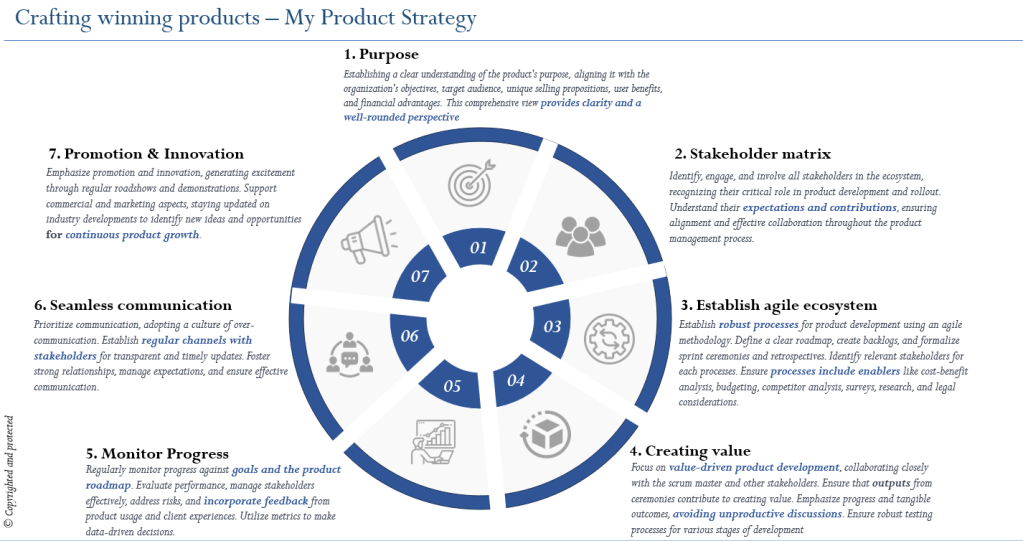
Success of a product greatly depends on a well-defined product strategy which acts as a compass that guides organizations. It provides clarity, aligns objectives, and ensures that products are not just developed but thrive in the market. I have refined and relied on seven keys to developing a robust product strategy. The keys include mission & purpose, stakeholders landscape, product development process, value creation, progress monitoring, seamless communication, and promotion & innovation. Let’s delve into each of these steps to understand how they contribute to a comprehensive and effective product strategy.
Step 1: Purpose – Defining the North Star
A product strategy begins with a clear understanding of the product’s mission purpose. I find this step fundamental for establishing the right direction for the product for the obvious reason. Without mission, without knowing what difference you expect the product to make in the ecosystem, without knowing what values your product stand for , without knowing what problem it aims to solve there is no product. But mission is not the only thing what we need to confirm at this stage. There are host of others which I have listed below:
-
Define product mission, values
As mentioned this is critical. Define a grandiose mission. Something like Product XYZ will be the top product of choice when the user wants to solve ‘problem’ or fill a ‘gap’ or Product XYZ will capture 40% of world market due to its transformational prowess. It needs to be BOLD, it need to be BIG. Anyone who is associated with the product should feel that they are backing a truly disruptive product, they should feel energised, proud of what the product does or is expected to do
-
Define the product market
We need to identify the market segment where we want to be product leader. Market segment define our subsequent approach on go to market, market research, identifying and tracking competition
-
Define what product success will look and feel like
It is important to establish what product success looks like over one year, 2 year , 5 year. It can be increase in market share or growing revenue from the product
The above steps will enable the product team to create a well-rounded perspective that serves as the guiding light throughout its lifecycle. This clarity ensures that every decision, from development to marketing, is aligned with the product’s core mission.
Step 2: Stakeholder Landscape- Collaborative Engagement
Once we have clarity on what the long term goals of the product, it is important to understand the stakeholder landscape which impacts the product. Obviously the most important stakeholder for the product will always be the ‘Customer’. But apart from Customer there are other stakeholders which need to be identified along with their stakes in the product. This is critical as understanding the stakes of respective groups will ensure that engagement model with each of the stakeholder gets defined which in turn will lead to the right outcome for the product and the organisation. Key categories of stakeholders that need to be considered are:
- Customers
- Competitors
- Sponsors and Management
- Business Development
- Other Internal Departments
- Product Development Team
For each category of stakeholders a set of questions need to be answered:
- What is the role of the stakeholder vis a vis the product
- What is the expectation of the stakeholder
- How does the product team plans to engage with the stakeholder
- What is the information (if any) needed from the stakeholder and at what frequency
- What is the information (if any) to be shared with stakeholder and at what frequency
- What is the engagement model with each of the stakeholders
- How will the inputs from any of the stakeholder make its way back to if required to refine the vision or the product roadmap or backlog
We will define each of the above stakeholder along with a framework in a separate article
Step 3: Establish an Agile Ecosystem – Navigating the Development Journey
Assuming we plan to use the agile framework for building the framework, it is essential to establish an effective governance model for managing the product development. This can again be explained through a set of questions which should be answered:
- How many sub products will the product build be split into?
- How long will be the sprint cycle
- What will be an ideal cross functional team? How many teams would be needed
- What will be the sprint acceptance process?
- Establishing standards of user stories
- Process for sprint planning, sprint refinement, sprint retrospective
- Tools to be used for managing backlog and roadmap
- How will the outputs from stakeholder engagement model be incorporated with the backlog and roadmap
- Clarity on right level of update for various stakeholders
- Clear understanding with technology around deployment, testing and path to live
A scum master along with product manager and technical lead should take an active lead in this space. Having these questions sorted right at the beginning ensures the actual build and rollout of the product is highly efficient.
Step 4: Creating Value – The Heart of Product Development
This is where the rubber meets the road, where the Product Manager would ensure that product roadmap along with product backlog starts taking shape based on the requirements gathered. Requirements are nothing but the result of the interaction with the interaction with various stakeholder groups. Without doubt customers will provide majority of the requirements but requirements can also come from other stakeholders as well. For instance compliance team can provide specific requirements related to GDPR regulations, technology team can highlight requirements related to cyber security and so on. In this step sprint is put into action where the structure put in place for product development starts churning out features iteratively. Features are tested, reviewed and feedbacks are gathered and the cycle repeats.
After a set of features are ready, they are packaged as a version of the product and then tested across environments before being made ‘live’ in the production environment. Important to note that based on the strategy the rollout of the version can start with a small group of targeted users and when the team feels adequately confident with the version, the same can be rolled out to wider audience. There are loads of idiosyncrasies involved in this area something we can cover at length when we discuss individuals at length
Step 5: Monitor Progress – Data-Driven Decision Making
It is a well-established control maxim that ‘what cannot be measured cannot be controlled‘. So is true with product as well. Regularly monitoring progress against goals and the product roadmap is essential for steering the product in the right direction. Customer feedback is the pulse of the product health. Reactions and feedbacks from the customers need to be systematically gathered, assessed, converted to requirement and added to the backlog. Similarly Product team should ensure that outcomes of monitoring and analysis of various areas like technology, entity risk management, operations are managed well. The follow up action from monitoring and control initiatives need to be give n high priority with periodical review and disciplined addressing of each and every assessment/ feedback/ complaints etc. Metrics play a crucial role in making data-driven decisions, providing insights into what is working and where adjustments are needed. Continuous progress monitoring ensures that the product remains on track to achieve its objectives.
Step 6: Seamless Communication – The Glue that Binds
If you review any of the previous steps, it will be obvious that communication will be an integral part of it. However I have specifically called out communications as an independent area due to its criticality in the overall product management approach. Especially given its never a case that one size fits all when it comes to communicating. So the communication with the customers’ needs to be a different approach than the one with top management or other with regulatory organisations. I am highly in favour of having a dedicated owner to communicate with various stakeholders. This will ensure that there is a clear strategy and approach for each group of stakeholder. It is equally imperative right format of communication format is agreed for the relevant stakeholder. Communication formats can include weekly reports, monthly newsletter, one to one meetings, workshops, marketing initiatives etc.
Step 7: Promotion & Innovation – Sustaining Growth
The final step in crafting a winning product strategy revolves around promotion and innovation. Promotion is all about brand building. Strategic planning should ensure that world recognises the brand by its quality standards, values, social responsibility, ethics and relevant to the times. This should be differentiated from marketing and promoting the product which can be considered as part of the communication.
Equally important is that product continues to disrupt and innovate new capabilities. In this regard it is imperative to stay updated on industry developments and trends, what is working and what is becoming obsolete. This is especially true for companies which have had relied on legacy products for their success. Clayton Christensen’s disruptive innovation is high relevant here(will be covered as a separate topic). A forward looking attitude towards innovation ensures the product stays ahead of its competitors.
 ProductSME