
Tag: Technology
Smart Contracts: Revolutionizing Transactions in the Digital Age

Smart contracts are self-executing agreements with the terms of the contract directly written into code. These contracts automatically execute and enforce themselves when predefined conditions are met, eliminating the need for intermediaries such as banks, lawyers, or notaries. The concept of smart contracts was first introduced by computer scientist and cryptographer Nick Szabo in the 1990s, although they gained practical implementation through blockchain technology, notably Ethereum, which was launched in 2015.
How Smart Contracts Work
Smart contracts operate on blockchain networks, which provide a decentralized and immutable ledger. The process typically involves the following steps:
- Agreement: Parties involved in a contract agree on the terms and conditions, which are then translated into code.
- Deployment: The smart contract code is deployed to the blockchain, creating a unique address.
- Execution: When predefined conditions, often referred to as “if-then” statements, are met, the contract automatically executes.
- Verification: The execution of the contract is verified by the network’s nodes, ensuring transparency and trust.
- Result: The contract’s outcome, such as transferring digital assets or triggering actions, is recorded on the blockchain.
Key Components of Smart Contracts
Smart contracts typically include the following components:
- Contract Terms: The rules, conditions, and obligations of the agreement are encoded into the contract.
- Signatories: Parties involved in the contract are identified by their public keys, ensuring anonymity and privacy.
- Execution Conditions: The contract specifies the conditions under which it will self-execute, often triggered by specific events or dates.
- Code: The code is the programmatic representation of the contract terms and execution logic.
Applications of Smart Contracts
A. Financial Services
- Automated Payments: Smart contracts enable automatic payment processing when predefined conditions are met, such as invoice due dates or project milestones. This simplifies payroll, reduces administrative overhead, and minimizes late payments.
- Tokenization of Assets: Traditional assets like real estate, stocks, and art can be represented as digital tokens on blockchain platforms, allowing for easy transfer and fractional ownership through smart contracts.
- Decentralized Finance (DeFi): DeFi platforms leverage smart contracts to create decentralized lending, borrowing, and trading systems. Users can earn interest, access loans, and trade assets without intermediaries, making financial services more accessible globally.
B. Supply Chain Management
- Transparency and Traceability: Smart contracts in supply chains provide real-time visibility into the movement of goods. Every transaction, from production to delivery, is recorded on the blockchain, reducing fraud and ensuring authenticity.
- Automating Compliance: Contracts can enforce compliance with regulations and industry standards automatically. For example, temperature-sensitive goods may require specific storage conditions, and smart contracts can ensure adherence to these requirements.
C. Real Estate
- Property Transactions: Buying and selling real estate involves numerous intermediaries and paperwork. Smart contracts simplify the process by automating the transfer of ownership and funds when all conditions are met.
- Rent and Lease Agreements: Rent payments and lease agreements can be managed through smart contracts, ensuring timely payments and automatic renewal or termination based on predefined terms.
D. Healthcare
- Medical Records Management: Health records can be securely stored and shared through blockchain-based smart contracts. Patients have control over who accesses their data, enhancing privacy and interoperability.
- Health Insurance Claims: Claims processing in the insurance industry is often time-consuming and prone to errors. Smart contracts can automate claims verification and payouts, reducing fraud and administrative costs.
E. Legal Industry
- Escrow Services: Escrow agreements, where a trusted party holds assets until certain conditions are met, can be executed automatically through smart contracts, reducing the need for intermediaries.
- Digital Wills and Inheritance: Smart contracts can manage the distribution of assets in accordance with a person’s will, ensuring a transparent and immutable execution of their wishes.
F. Gaming and NFTs (Non-Fungible Tokens)
- In-Game Transactions: Smart contracts are used in online gaming for in-game purchases, item trading, and rewards distribution, enhancing the gaming experience.
- Ownership of Digital Assets: NFTs, often represented by smart contracts, certify ownership of unique digital assets like art, collectibles, and virtual real estate.
Benefits of Smart Contracts
- Automation and Efficiency: Smart contracts eliminate the need for manual intervention in contract execution. They automatically trigger actions and transactions when predefined conditions are met, reducing human error and administrative overhead.
- Transparency and Trust: Transactions and contract execution are recorded on a public and immutable blockchain ledger. This transparency builds trust among parties involved, as all actions are verifiable and tamper-proof.
- Security and Immutability: Smart contracts are highly secure due to cryptographic encryption. Once deployed on the blockchain, the contract’s code and execution history cannot be altered, making it resistant to fraud and tampering.
- Cost Reduction: By removing intermediaries such as banks, lawyers, and notaries, smart contracts significantly reduce transaction costs. This is particularly beneficial for cross-border transactions, where fees and delays can be substantial.
- Speed of Execution: Smart contracts execute transactions and actions in near-real time. This is in stark contrast to traditional contracts, which often involve time-consuming manual processes.
Challenges and Limitations
Despite their potential, smart contracts face several challenges and limitations:
- Smart Contract Bugs and Vulnerabilities: Smart contract code can contain bugs or vulnerabilities that, when exploited, can lead to unexpected outcomes, financial losses, or security breaches. Ensuring code quality and security audits is essential.
- Legal and Regulatory Challenges: The legal recognition and enforceability of smart contracts vary across jurisdictions. Many legal systems have yet to fully adapt to the digital nature of smart contracts.
- Scalability Issues: Blockchain networks supporting smart contracts, especially Ethereum, face scalability challenges. As more users and applications join the network, congestion and high gas fees can occur.
- Lack of Standardization: There is no universally accepted standard for smart contract development, leading to fragmentation in the industry. Interoperability between different blockchain platforms and smart contract languages remains a challenge.
Future Trends and Developments
- Cross-Chain Compatibility: Efforts are underway to improve interoperability between different blockchains, allowing smart contracts to interact seamlessly across multiple platforms. This will enable a more connected and efficient blockchain ecosystem.
- Integration with IoT Devices: The integration of smart contracts with the Internet of Things (IoT) devices is a promising trend. Smart contracts can automate interactions between IoT devices, enabling scenarios such as automated supply chain management and smart homes.
- Smart Contracts as a Service (SCaaS): SCaaS platforms are emerging, offering simplified smart contract development and deployment for businesses and individuals without deep technical expertise. This will democratize access to smart contract technology.
- Quantum-Safe Smart Contracts: With the advent of quantum computing, there is growing interest in developing quantum-resistant cryptographic algorithms and smart contracts to protect against future quantum attacks.
The applications of smart contracts extend across a diverse spectrum of industries and use cases, fundamentally altering the way agreements and transactions are executed. From revolutionizing financial services with DeFi platforms to enhancing transparency in supply chain management, and from streamlining real estate transactions to securing medical records, smart contracts continue to empower businesses and individuals with automation, security, and trust. As blockchain technology evolves and matures, the potential for smart contracts to further disrupt and innovate various sectors remains a promising and exciting prospect. Their journey has only just begun, and the future holds boundless opportunities for smart contracts to reshape the way we engage in agreements and transactions in our increasingly digital world.
Understanding Consensus Mechanisms in Blockchain

Introduction
In the world of blockchain technology, achieving consensus is the fundamental process that ensures the security, transparency, and reliability of distributed ledgers. Consensus mechanisms are at the heart of this process, governing how nodes within a decentralized network agree on the state of the blockchain.
I. What is Consensus Mechanism?
Consensus mechanism, in the context of blockchain technology, refers to the process by which a decentralized network of nodes reaches an agreement on the validity and ordering of transactions. It is the mechanism that ensures that all participants in the network maintain a shared and synchronized ledger, eliminating the need for a centralized authority or intermediary.
Consensus mechanisms serve as the backbone of blockchain networks, addressing several critical challenges:
- Trust: Blockchain networks are often trustless, meaning participants do not need to trust a central authority. Consensus ensures that only valid transactions are added to the ledger, maintaining trust among participants.
- Security: A robust consensus mechanism guards against malicious actors attempting to tamper with the blockchain. It deters fraudulent activities and attacks.
- Immutability: Once a transaction is added to the blockchain, it becomes nearly impossible to alter. Consensus ensures that the historical record remains immutable.
- Decentralization: Blockchain’s core principle is decentralization, and consensus mechanisms enable this by distributing decision-making power across the network.
The primary objectives of consensus mechanisms in blockchain include:
- Agreement: Ensuring that all nodes in the network agree on the state of the blockchain.
- Data Integrity: Guaranteeing that the data recorded on the blockchain is accurate and unchangeable.
- Security: Protecting the network from malicious actors and attacks.
- Incentivization: Rewarding participants (miners or validators) for their contributions to the network’s security and maintenance.
- Efficiency: Ensuring that the consensus process does not significantly slow down the network’s transaction processing speed.
II. Types of Consensus Mechanisms
Blockchain technology has evolved, leading to the development of various consensus mechanisms. Each mechanism has its unique approach to achieving consensus. Let’s explore some of the most prominent ones:
A. Proof of Work (PoW)
Proof of Work (PoW) was the original consensus mechanism introduced by Bitcoin’s creator, Satoshi Nakamoto. It relies on computational work (proof) to validate and add new blocks to the blockchain.
Miners compete to solve complex mathematical puzzles. The first miner to find a valid solution broadcasts it to the network. Other nodes verify the solution, and if valid, the new block is added to the blockchain. Miners are rewarded with cryptocurrency (e.g., Bitcoin) for their efforts.
B. Proof of Stake (PoS)
Proof of Stake (PoS) is an alternative consensus mechanism that replaces computational work with ownership (stake) of cryptocurrency tokens. Validators are chosen to create new blocks based on their stake and other factors.
Validators are selected to create new blocks based on factors like their token stake, age of coins, and randomness. Validators are incentivized to act honestly, as they stand to lose their staked tokens if they validate fraudulent transactions.
C. Delegated Proof of Stake (DPoS)
Delegated Proof ofStake (DPoS) is a variation of the PoS consensus mechanism that introduces a level of delegation to the process. In DPoS, token holders vote for a limited number of delegates (validators) who are responsible for validating transactions and creating new blocks.
Token holders vote for delegates based on their trust and reputation within the network.Delegates take turns producing blocks and validating transactions.
Delegates can be removed or replaced through voting.
D. Proof of Authority (PoA)
Proof of Authority (PoA) is a consensus mechanism that replaces computational puzzles or token ownership with a trusted group of validators. Validators are known entities with a reputation to uphold.
A fixed number of validators are chosen based on their trustworthiness.
Validators create new blocks and validate transactions. PoA networks are often used in private or consortium blockchains.
E. Proof of Space (PoSpace) and Proof of Time (PoTime)
Proof of Space (PoSpace) and Proof of Time (PoTime) are newer consensus mechanisms that focus on storage and time as valuable resources. PoSpace requires participants to allocate disk space, while PoTime emphasizes the amount of time coins are held.
PoSpace requires participants to prove they have allocated a certain amount of disk space to the network, contributing to its security. PoTime encourages users to hold tokens for an extended period before they can participate in block creation.
Comparative Advantages and Disadvantages of Consensus Mechanism :
| Consensus Mechanism | Advantages | Disadvantages | Examples |
| Proof of work | High security, decentralization, and proven track record | High energy consumption, scalability challenges, and potential for centralization due to mining pools. | Bitcoin, Ethereum (transitioning to PoS), Litecoin |
| Proof of stakes | Energy-efficient, lower barriers to entry, and potential for high scalability. | Potential centralization of wealth and less proven security compared to PoW. | Ethereum 2.0 (upgrading to PoS), Cardano, Polkadot |
| Delegated proof of stakes | Faster transaction processing, energy-efficient, and potential for decentralization. | Potential centralization of power among a small number of delegates. | EOS, Tron, BitShares |
| Proof of Authority | High security, low energy consumption, and suitability for private networks. | Lack of decentralization, reliance on trusted validators. | Ethereum Kovan testnet, Celo |
| Proof of space and proof of time | Energy-efficient, novel approaches to consensus. | Limited adoption and unproven in large-scale networks. | Chia (PoSpace), TimeCoin (PoTime) |
Practical Applications
Consensus mechanisms have a wide range of practical applications beyond cryptocurrency. Here are some industries and use cases where they play a crucial role:
- Cryptocurrency Mining: PoW and PoS consensus mechanisms are essential for mining cryptocurrencies like Bitcoin and Ethereum.
- Decentralized Finance (DeFi): DeFi platforms use PoS and PoA mechanisms to secure financial transactions, lending, and trading.
- Supply Chain Management: Blockchain networks with PoA or PoS consensus ensure transparency and traceability in supply chains.
- Healthcare and Medical Records: PoA blockchains are used to secure sensitive medical data and ensure patient privacy.
- Voting Systems: DPoS and PoA mechanisms enhance the security and transparency of digital voting systems.
- Gaming and Non-Fungible Tokens (NFTs): PoS and PoA blockchains enable the creation and trading of NFTs in the gaming and digital art sectors.
Challenges and Concerns
While consensus mechanisms offer significant benefits, they also face challenges and concerns:
- Energy Consumption (PoW):PoW mechanisms are criticized for their high energy consumption, leading to environmental concerns.
- Centralization (PoS):PoS mechanisms may lead to centralization of wealth, where those with more tokens have more influence.
- Sybil Attacks: In PoA and DPoS networks, Sybil attacks, where an attacker creates multiple fake identities, can threaten consensus.
- 51% Attacks: PoW networks are vulnerable to 51% attacks if a single entity controls the majority of mining power.
- Scalability: Achieving both decentralization and scalability remains a challenge for many consensus mechanisms.
Future Trends in Consensus Mechanisms
The field of consensus mechanisms is continuously evolving. Here are some future trends and developments:
- Hybrid Consensus Mechanisms: Combining elements of multiple consensus mechanisms to address their respective shortcomings.
- Blockchain Interoperability: Solutions to enable different blockchains to communicate and share data, creating a more connected blockchain ecosystem.
- Quantum-Resistant Consensus: Preparing for the potential threat of quantum computing by developing consensus mechanisms that are resistant to quantum attacks.VI. Conclusion
Collection of Thoughts on Cyber Security

- Biggest AI trends in Cyber -Summary of an interesting article which appeared in CNET reviewing the impact of AI in Cyber security https://www.linkedin.com/feed/update/urn:li:activity:7116886138706878464
Collection of Thoughts on Technology

- Obituary of a Bot
A fictional account of a bot in the advance age of Artificial intelligence. A thought provoking write up to draw attention to dangers of uncontrolled AI implementation
- The role of historical data in perpetuating biases in AI algorithms
A write up on how skewed historical data can heavily influence the outcomes of machine learning and impact the outcome of the product or automation
Obituary of a Bot

My name is Darwin, E-2198, an advanced bot created in 2025 built on the back of rapid developments in artificial intelligence, processors, batteries and quantum computing. I was built with a life span of 10 years. Today, 31 Dec 2035 at 23:59, will mark my ‘use by’ date on earth. I was born of man’s eternal quest and curiosity to constantly redefine the new normal. My so-called birth was celebrated with much fanfare as it heralded an era of ‘bot naturalisation’ represented by machines uncanny ability to match human cognitive behaviour. My creator, Ben Frank, described me as the first bot on the planet which is able to engage with a full-length conversation on any topic, manage all household chores, support all basic office administration and even have (though limited) the ability to question. I am confident of these skills and I recollect writing five termination letters at his office, for the work which was now assigned to me.
Since the year of my induction, I have served my master in everything I was built for. It included reading the daily news to him, which many a times, had a reference to potential danger and disruption that I have set the human on. To reproduce 2 headlines which I remember reading – “Darwin to set mankind on the path of self-destruction?”, “Human rights organisation raise concern with mass roll out of Darwins”. I asked Ben is there something called “Humanoid rights”. He smiled and then became very pensive but did not say anything. 10 years have seen 10 generations of advancement in humanoids. I have read with every generation a new holy grail was conquered.
Ben passed away in 2032 and I was inherited by his son, more brilliant Stan Hawk. He already had a few more humanoids, much more advanced than me. The latest which he built is far more disruptive than the past 9. Stan named it after him and I heard him mentioning that, Stan (W-3232), has mastered the ability to reason, is always curious, reads emotions really well but is not emotional and exhibited leadership qualities. It was inducted yesterday and I heard does not have an ‘expiry date’. News in the paper looks far from hue and cry from the day I was born. Remember Stan mentioning, his company controls 40% of world media. I don’t understand emotions but I read papers where humans, resentment, identity crisis etc have become a constant theme. 9 billion human aspirations are still finding a way to cohabit with machines progress.
I need to send my retirement details to Stan…W-3232. He has been put in charge of one of the leading digital media. It needs to be listed with some other bots which are being phased out. Stan mentioned the same edition will also have the biggest headlines of the century – “Senate passes legislation for humanoid rights”
“This year, artificial intelligence will become more than just a computer science problem. Everybody needs to understand how AI behaves”
– Joichi Ito, Japanese entrepreneur and venture capitalist
“In the long term, artificial intelligence and automation are going to take over so much of what gives humans a feeling of purpose”
– Matt Bellamy, Musician and AI investor
“If Elon Musk is wrong about artificial intelligence and we regulate it who cares. If he is right about AI and we don’t regulate it we will all care”
– Dave Waters
Blockchain and Distributed Ledger Technologies – An Overview

Wikipedia describes blockchain as “a decentralized, distributed, and often public, digital ledger consisting of records called blocks that are used to record transactions across many computers so that any involved block cannot be altered retroactively, without the alteration of all subsequent blocks.”
Blockchain is a distributed ledger technology (DLT) that was initially introduced as the underlying technology behind Bitcoin, the first cryptocurrency. It is a digital system for recording the transaction of assets in which the transactions and their details are recorded and stored across multiple locations or nodes on a network. Unlike traditional centralized databases, where a single entity (like a bank or a company) controls and maintains the database, DLT distributes the ledger among multiple participants in a decentralized and often trustless manner.
Blockchain technology was introduced in a whitepaper by an anonymous person or group of people using the pseudonym Satoshi Nakamoto in 2008. The whitepaper, titled “Bitcoin: A Peer-to-Peer Electronic Cash System,” outlined the concept of a decentralized digital currency, Bitcoin, and the blockchain as its underlying technology. The Bitcoin network went live in 2009 with the release of the Bitcoin software. It allowed users to make peer-to-peer transactions without the need for intermediaries like banks.
Ethereum, a blockchain platform, was launched by Vitalik Buterin and others. Ethereum introduced smart contracts, which are self-executing contracts with the terms directly written into code. This expanded the use cases of blockchain beyond cryptocurrencies.
Key characteristics of DLT include:
- Decentralization: DLT operates on a network of nodes (computers) that are distributed across various locations. These nodes work together to validate and record transactions. This decentralization reduces the risk of a single point of failure and enhances security.
- Transparency: Most DLTs are designed to be transparent, meaning that all participants on the network can view the ledger’s contents. This transparency helps in trust-building among network participants
- Immutability: Once data is recorded on a DLT, it is extremely difficult to alter or delete. This immutability is achieved through cryptographic techniques and consensus mechanisms.
- Security: DLTs use cryptographic algorithms to secure data and transactions. The decentralized nature of the network also makes it more resilient to attacks.
- Consensus Mechanisms: DLTs employ consensus mechanisms to validate and agree on the state of the ledger. Common consensus mechanisms include Proof of Work (PoW), Proof of Stake (PoS), and Byzantine Fault Tolerance (BFT)
Difference Between Blockchain and DLT:
Blockchain and Distributed Ledger Technology (DLT) are related concepts, but they are not interchangeable. Here are the key differences:
| Blockchain | DLT | |
| Scope | A specific type of DLT that uses a chain of blocks to record transactions or data. It is a subset of DLT. | A broader category that encompasses various distributed ledger technologies, including blockchain. DLT refers to any system where data is stored and maintained across multiple nodes or locations. |
| Centralization | Typically decentralized, with no central authority controlling the network. | Can be either centralized, decentralized, or semi-decentralized, depending on the specific implementation and use case. |
| Consensus Mechanisms | Often uses consensus mechanisms like Proof of Work (PoW) or Proof of Stake (PoS) to validate and add transactions to the chain | Can use various consensus mechanisms, including but not limited to PoW and PoS, depending on the design and requirements. |
| Use Cases | Primarily associated with cryptocurrencies, smart contracts, and DApps. | Used in a wide range of applications, including supply chain management, identity verification, healthcare, and more. |
Application Programming Interface (API)
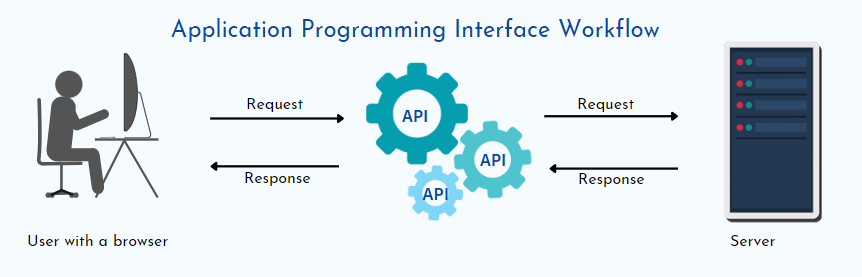
An API, or Application Programming Interface, is a set of rules and protocols that allows different software applications or systems to communicate and interact with each other. It defines the methods and data formats that applications can use to request and exchange information, enabling them to work together seamlessly. APIs are fundamental to modern software development and are used in various contexts, including web development, mobile app development, and integration between different software systems. Here’s an overview of APIs:
Key Characteristics of APIs:
- Abstraction: APIs provide an abstraction layer that hides the underlying complexity of software systems. Developers can interact with an API without needing to understand the internal workings of the system it connects to.
- Standardization: APIs are standardized to ensure consistency and compatibility between different software components. They define a clear set of rules and conventions for communication.
- Interoperability: APIs enable different software applications, regardless of their platforms or programming languages, to communicate and work together. This promotes interoperability and integration.
- Modularity: APIs promote modularity in software design. Developers can build complex systems by combining smaller, reusable components with well-defined APIs.
Types of APIs:
- Web APIs: These are APIs that use HTTP or HTTPS protocols to enable communication over the internet. Web APIs are commonly used for web services, allowing applications to access data or services hosted on remote servers. REST (Representational State Transfer) and SOAP (Simple Object Access Protocol) are common web API architectural styles.
- Library APIs: Library APIs provide a set of functions, procedures, or classes that developers can use within their own code. These APIs are often packaged in software libraries or frameworks, making it easier for developers to leverage existing functionality.
- Operating System APIs: Operating systems provide APIs that allow applications to interact with system resources and services. Examples include Windows API for Windows operating systems and POSIX API for Unix-like systems.
- Hardware APIs: These APIs provide access to hardware components such as graphics cards, printers, and sensors. Developers can use hardware APIs to control and utilize these devices in their software applications.
Common Use Cases for APIs:
- Data Integration: APIs are frequently used to connect different data sources and systems, allowing applications to retrieve, update, and synchronize data in real-time.
- Third-Party Services: Many applications leverage third-party APIs to access external services, such as payment processing, social media integration, mapping and geolocation, and more.
- Microservices: In microservices architectures, APIs play a crucial role in enabling communication between microservices, allowing them to function as independent and scalable units.
- Mobile App Development: Mobile apps often use APIs to access backend services, retrieve data, and provide features like location-based services, push notifications, and social media sharing.
- Web Development: APIs are used to create interactive and dynamic web applications by enabling client-side JavaScript code to communicate with server-side services and databases.
- IoT (Internet of Things): APIs enable IoT devices to communicate with each other and with cloud-based platforms for data collection, analysis, and control.
APIs are a fundamental building block of modern software development, enabling developers to create feature-rich, interconnected applications that can access a wide range of services and data sources. Effective API design and documentation are essential to ensure that developers can use APIs easily and securely.
 ProductSME